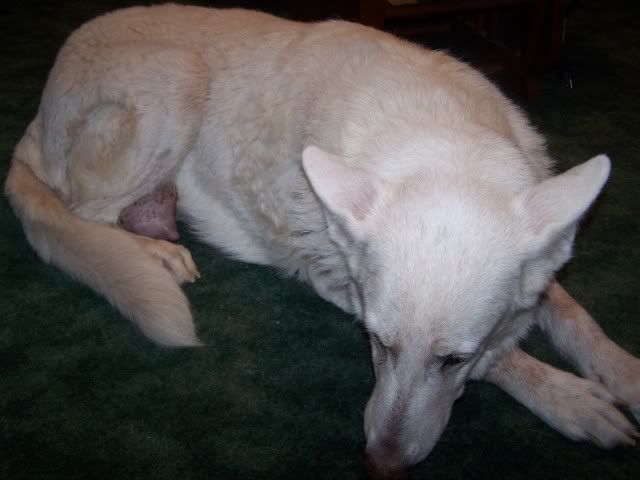
Thursday, August 18, 2011

Mila's Excellent Adventure

 ---->Immiticide Unavailability<----

Well, maybe adventure is too strong a word.

He's cool.
In addition to inactivity, it is important to keep a dog that is undergoing heartworm treatment cool. Not as in Joe Cool. Though he is awesome!

He may be cooler. Thanks, Kathy for the pic!
But keeping them from being hot and panting and increasing risks for clotting (yes, we mentioned clots or clotting again) is really important.


It's been a hot summer so Mila has been in the AC, and just briefly out for potties as you've seen.


But the other day, it was cool. There was a breeze. It was beautiful. It's later into the month after her first injection and we decided as long as she didn't get excited by being brushed, that we could perform that task for the first time since her injection. We hate to say it, but people do call these dogs German Shedders for a reason. She was losing her stuffing.
Oof, looking a little rough. But that patch of fur is growing back!
Is this all me? Mila checks out her post-grooming Tribbles.


I feel pretty...oh so pretty...
Her reward - and we see we missed some spots!
Ahhhhhhh...
Thanks for that!
We were even able to sit out and enjoy a second day without her getting overheated, but it has gotten hot since then. Hopefully in her next month of treatment, there will be some cooler days and some nice time spent under a tree together.

So what did we learn today?
1. As always, leash potties only and super limited activity
2. Keep your dog cool during treatment - air conditioner level cool.

Next time, honestly, we will look at the types of treatments!

Monday, August 15, 2011

Cost of Treatment, Cost of Prevention

--->Immiticide unavailability information click here<---

This unavailability is even making the news: http://articles.kspr.com/2011-08-12/heartworm_29882623 (snipped some - so not direct quotes below)
"If the dog is already sick from the disease it will be a big deal."  It takes a dog two years from when the infection is contracted to show symptoms.  So now, more than ever, Hale is pushing regular testing and preventative measures. At Hale's practice only 40% of the regular patients use some kind of heartworm prevention and if you include all the dogs he sees for just emergencies that statistic drops to 20%. "It's not all due to cost.  A lot of it is they don't understand or don't know."
But unlike the past there's no back-up plan.
And as always, our poor shelter dogs teach us the lesson in the harshest ways:
http://www.myfox8.com/news/wghp-lack-of-heartworm-medication-leading-to-euthanizations-20110812,0,3791678.story  

If you are in the Greensboro, NC area though, you can help by fostering or adopting a HW+ dog and starting to follow the AHS recommendations linked at the top of this post.

A shortage of the fastest treatment for heartworm medicine has led some Triad animal shelters to euthanize dogs with the condition.
Guilford County Animal Shelter director Marsha Williams said she has enough doses to treat two dogs. However, as she recently took in 21 dogs that had the condition, she said she is left with no choice but to euthanize them.
"It's devastating for us," Williams said.
We were going to talk about the types of treatment in this post - that will be another time. We are going to hope that the Immiticide unavailability ends in the next few months. Everyone hope together for that.

But right now, there is a situation with the unavailability of Immticide, so it is even more important for all of us to be telling people about preventing this disease. That's the education part the vet above is talking about.

We can be part of that. (you can like this post on Facebook, Twitter, your own blogs, etc, below, at the bottom of this post - help to educate with a simple click) You can copy and paste our materials too if you would like, just link back to the blog.

Also as that vet said in the first news article, in this economy, people are understandably looking for ways to cut costs. The yearly heartworm test and the purchase of prevention medicines could be one thing to go. This is one thing though that may cost much more in the long run - to the pet's health, and to the owner in terms of money.

Lots of times it looks like people are buying their whole year supply of heartworm meds all at once at the vet office, and that's a bigger expense in one bill for sure. If you are close enough to make it cheap enough, you can also purchase them every month, so it fits the budget better.

People also often look at, but really need to be careful with, the cheaper online medicines. These are not always real meds! Whole Dog Journal recommended that you look for a VIPPS pharmacy: http://nabp.net/programs/accreditation/vet-vipps/find-a-vet-vipps-online-pharmacy/ which you can do right there - we are all about making things easy on this blog!

Check to see if these pharmacies will pay for heartworm treatment if your pet should become HW+ even if you give the meds every month. Vet offices may do so - ask them too while you're out asking so many questions! Side note - make sure if you give Heartgard that you break it up or that your dogs will chew the medicine.

Anywhooo, cost of prevention is pretty cheap compared to cost of TREATING heartworm disease. The money part and the whole wear and tear on the body part as well, obviously! No one wants to feel like they are in heart failure, that's for sure, and that's what heartworm disease is good at doing as it advances.

But let's talk money! Where we are, heartworm treatment for a medium sized dog costs about $700, if you get a good deal. In other areas of the country it can be much higher.

When we started this blog, we had 4 heartworm positive dogs. Now there are 7.  Let's not do that math.

So 4 HW+ dogs = approximately $2800

$2800 = 336 large dog Interceptor heartworm prevention pills at current costs.

That's enough for 28 years of heartworm pills for one dog, if given year round. Obviously a silly thought!

Or 7 years of heartworm pills given year round per dog at prices found from a reputable online pet pharmacy.

So the this or that between prevention and treatment once again makes prevention the better choice.


Friday, August 12, 2011

Well, what *CAN* I do? (nothing, Mila)

------> Immiticide Unavailable  <--------

Just keeping that Immiticide issue above in front of all of us. We did call to check, and Mila should be set for her next injections, but we will probably have to call again just to satisfy that little OCD tendency. Maybe one more time after that. Wonder if they will let us go over with a little sticker that says Mila and put it on the vials?

So on to the idea of restriction of activity (not even exercise - exercise is out of the question - exercise: heartworm as Frisbee: ligament) after heartworm treatment. Lots of times when things happen with our pets, the big thing happens at the vet office in terms of treatment, but we often forget that our part is also important. Hip surgery - being compliant with the aftercare can prevent serious issues with the implant. We get it. Bloat/GDV - making sure you take care of that stomach with smaller meals as instructed by the vet. We understand.

But for some reason, people think they can do a leeeeeeeetle more than recommended with heartworm treatment aftercare. And maybe they will get away with it. However, if they don't, the result to the dog can be deadly. There is a reason best practices are called best. 

From: http://projectspayneuter.com/petowner/heartworm.htm They even CAPPED IT!
Strict exercise restriction. THIS IS THE MOST IMPORTANT PART OF THE TREATMENT PROCESS.  This is THE ONE thing owners can do to reduce the risk of serious complications.  Dogs who have been treated for heartworm disease should receive the absolute minimum of exercise for up to 4 months from the beginning of treatment.  Ideally, cage rest should be provided.  In very hyperactive dogs, a sedative may need to be used to help achieve this very important goal.  Dogs should be walked on a leash, not turned loose, for toilet duties.
And again here: http://www.petplace.com/dogs/heartworm-disease-in-dogs/page1.aspx
Exercise restriction is so important, because as the drugs are killing the worms in the arteries, the worms can break off and travel to block parts of the blood vessels (pulmonary thromboembolism or PTE). PTE results in obstruction of the blood flow to parts of the lung (pulmonary infarction). Keeping the dog quiet allows the body time to slowly break down and absorb the dying worms.
What are you looking for - how do you know something is wrong? http://www.houstoncollierescue.org/download_info_files/heartworm%20treatment%20aftercare.pdf is a good read. They have a nice disclaimer, and we also say - always call your vet - and talk to your vet about this before and after treatment to be sure that you are all on the same page. None of this is a replacement for the knowledge and expertise of a doctor, and if you can, find a doctor who has done heartworm treatment before.
1.Keep an eye on the gums; they should be pink. If they get very red or white, along with listlessness, call us and take the dog to the vet: the dog may have a secondary infection (red gums) or anemia/shock (white gums) and need quick intervention.
2. Pay close attention to combination of lethargy, increased respiration, restlessness, and coughing; if you note these symptoms after treatment, call us and take the dog to the clinic. She will probably be put on Prednisone and will respond quickly.
3. Watch for vomiting or any bloody discharge combined with listlessness, fever, rapid breathing/heart rate, and pale gums. Although extremely rare, also watch for hindquarter paralysis and urinary incontinence. With the symptoms in (3), which are life‐threatening, the dog goes immediately to the nearest Vet Clinic because the signs point to embolism (worm clot from the die‐off of the parasites during treatment); the doctors will keep her overnight, possibly a couple of days or even a week, put her on IV to hydrate her, sometimes oxygen if she's in distress, and give her cortisone injections to break up the clot.
Another http://www.petplace.com/dogs/heartworm-disease-in-dogs/page4.aspx:
Owners need to be very alert for the signs of PTE: coughing, fast or heavy breathing or fever. If these signs are noted, the dog should be presented for examination as soon as possible. If PTE is identified, it is usually treated with the administration of the anti-inflammatory drug prednisone. Oxygen may need to be administered until the dog is breathing more easily.

Some very mild coughing is to be expected after heartworm treatment. However, if the coughing is occurring frequently during the day, or if the dog coughs up blood, the dog should be examined. Any coughing should be reported to your veterinarian.
We know we've talked about these clots before and we will probably talk about clots again. Repetition is the mother of retention?

A HUGE (CAPS!) note on exercise restriction BEFORE (CAPS AGAIN!) heartworm treatment begins.
You say to yourself, oh, pish tosh, why would that be important? The worms aren't dying. I don't need to worry about the clots they keep talking about. I need to give my dog a month of doxycycline and I'm going to let them enjoy that last month of freedom  before 2-4 months of being quiet. Right?

Wrong! Sad study says that by letting dogs be more active after being diagnosed (and before treatment begins) they get sicker faster! Even if they have less heartworms to begin with.
As expected, the number of worms has an effect on the severity of disease, but of equal, if not greater, importance is the activity level of the dog.
Controlled studies have shown that dogs infected by surgical transplantation with 50 heartworms and exercise-restricted took longer to develop clinical disease and developed less pulmonary vascular resistance than dogs with 14 heartworms that were allowed moderate activity.
Or as they said in the Urgent Alert about the Immiticide Unavailability - see the CAPS - we know what that means:
Restrict ALL activity of the dog! Limit ALL exercise!
• The severity of heartworm disease is directly related to the activity level of the dog.
• As physical activity increases, pathology associated with adult heartworms increases.
So if you have a dog who tests positive for heartworm, you begin limiting activity immediately. At some point we'll talk about slow kill - that's almost 2 years of activity restriction. If you have a foster dog who is waiting to start treatment for whatever reason, restrict activity. Or your dog will get sicker, faster.

Am I at least allowed to shake my head? Potty #1, am.
I'm as still as statue for potty #2, at noon.
Am I done with my treatment yet? Last potty before too dark for potty pics.
And that was Mila's big day!

Urgent Post - Immiticide Unavailability - AHS Recommendations

Updating this 8/18/11 with information copied/pasted from the links.

http://heartwormsociety.org/UrgentAlert-8-9-11.pdf

The link above has all the information and recommendations from the American Heartworm Society - thanks to Mary Ann and Lisa for these links for the blog!

http://news.vin.com/VINNews.aspx?articleId=19471  is the article from the Veterinary Information Network - check out WHY this is happening here.
Immiticide availability has been shaky since early last year, when Merial, the animal health arm of Sanofi, reported that its U.S. supplier could no longer obtain the product’s active ingredient, and the FDA was hesitant to allow Merial’s overseas supplier to fill American orders. As a result, Merial stopped allowing veterinarians to simply order and stock the drug in an effort to conserve U.S. supplies and implemented a “restricted distribution program.” Translation: Veterinarians treating only severe cases of heartworm disease could access the drug on a case-by-case basis with approval from the company.

In an email exchange with the VIN News Service, Mahanes noted that Merial’s latest Immiticide supply problems are not tied to the troubles of 2010. Rather, it is “a new and separate manufacturing challenge," she writes.

“This situation is related to technical issues providing finished product to us. The finished product is made by a manufacturing company in the U.S.," she explains. "… We are working diligently to mitigate this situation, and there is a possibility that an alternate source of supply may be identified."
We will be calling Mila's vet to make sure that her second treatment is still set. (it is!)

Also - this is the why of the activity restriction when they are diagnosed - I don't think I've ever seen it put so clearly:

4. Restrict ALL activity of the dog! Limit ALL exercise!
• The severity of heartworm disease is directly related to the activity level of the dog.
• As physical activity increases, pathology associated with adult heartworms increases.

From that urgent alert and recommendations from the AHS (American Heartworm Society):

While the unavailability persists, heartworm-positive dogs should be managed to achieve three primary goals:
1. Reduce potential pathology from the infection.
2. Maintain the health of the dog until it can be appropriately treated.
3. Prevent additional heartworm infection of the dog.

These goals may be achieved by strict adherence to the following - basic overview:
1. Limit the activity level of the dog to reduce pathology. (Really important! More activity makes the dog SICKER FASTER)
2. Carefully place the non-protected dog on heartworm prevention. (see the PDF)
3. Administer doxycycline to reduce pathology and infective potential of heartworms.
The doxycycline protocol would be 1 month on, 2 months off, 1 month on, 2 months off, etc.

All the details to review with your veterinarian are in that PDF. You should probably print and bring the whole PDF with you so they can see the source of the information and all the footnoting stuff.

Thursday, August 11, 2011

Thank you to The Bark Magazine!

http://www.thebark.com/content/big-dog-big-heartworm

WOW!

Huge appreciation and big thanks to Lisa Wogan and The Bark (they have a GREAT blog, not to mention a superb magazine) for supporting our efforts to inform people about heartworm disease, on behalf of the dogs who cannot do this themselves. 

Mila says check her out on their Facebook page too, and she hopes that you like her, you really, really like her!  The Bark Magazine Facebook Page
I *am* big. It's the *pictures* that got small.

Wednesday, August 10, 2011

Stop Trying to Scare Us! Symptoms and More. . .

Nag, nag, nag. We're like those scary public health commercials in this blog. It's just that every time we do some research to add to the blog, we find scary stuff. Of course, we find scary stuff when we're looking for recipes, too. 

But heartworm disease can really hurt dogs; and we see so many dogs in rescue who are heartworm positive (because we test them - if we didn't test we wouldn't know we have HW+ dogs). Then on top of the heartworm disease, they are not in good shape otherwise. 


Cheyenne before
Cheyenne with Southern Cross German Shepherd Rescue was one such case. We can't remember if she had a tick disease or not, but if she didn't, it was probably because the ticks wanted a healthier subject! She was heartworm positive, stage 3, had a mammary tumor, staph, flea dermatitis, bad hips, chronic ear infections, was in heart failure, exercise intolerant. She did not respond well to the first shot of Immiticide to kill the adult worms, so only had the one shot and then went to the slow kill treatment method. 
And same dog - after
Because she had a rescue that backed her and a foster family who was willing and gifted in taking care of every need, in a planned systematic way, Cheyenne is now a healthy happy senior girl. So now that we've had a happy moment, back to the scary. And some of this is things we have already learned a bit about, but with a creepier, scarier twist. It's Halloween in August!

Symptoms 
(Again with this crazy foot long worm info - yes!) Adult heartworms can reach 12 inches in length and can remain in the dog’s heart for several years. 

Dogs can have some microfilariae (baby worms) in their blood and worms in their lungs without manifesting (to show plainly or clearly - why do these websites always make us go to the dictionary?)  the disease. Once the number of worms exceeds a certain number based on the size and activity level of the dog, however, the adult worms move to the heart and symptoms begin to occur. Very active dogs may experience symptoms with lower numbers of worms than couch-potato dogs. (Interesting and kind of scary since so many dogs like the couch so does that mean they are actually sicker longer before we know it? We need an on call vet service for neurotics with questions!)

The time lag between the initial infestation of microfilariae (baby worms) and reproduction by adult worms living in the heart is six-to-seven months in dogs. (That we knew - and is why we heartworm test dogs twice after they have not been using medicines for a long period of time, once in the beginning and then six-seven months later.)
Female heartworms bear live young – thousands of them in a day. (Again - scary - thousands of baby worms a day.) The babies circulate in the bloodstream for as long as three years, waiting to hitch a ride in a bloodsucking mosquito. (Good heavens - three years - that's super scary!) They undergo changes in the mosquito that prepare them to infect a dog, and they transfer back to the original host species the next time the mosquito bites. The process of change in the mosquito takes about 10 days in warm climates, but can take six weeks in colder temperatures. (Oh my gosh - freaky, scary Christoph Waltz mutating mosquitoes.)
The worms grow and multiply, infesting the chambers on the right side of the heart and the arteries in the lungs. They can also lodge in the veins of the liver and the veins entering the heart. (Not cool, man, not cool.)
The first sign of heartworm infestation may not manifest for a year after infection (doing damage all the time), and even then the EARLY SYMPTOM ALERT: soft cough that increases with exercise may be dismissed as unimportant by the owner. 
More: 
The cough worsens 
The dog may actually faint from exertion
They tire easily
They are weak and listless, 
Those lose weight and condition
They may cough up blood. 
Breathing becomes more difficult as the disease progresses. 
The progression is traumatic: the dog’s quality of life diminishes drastically and he can no longer retrieve a Frisbee (FRISBEE?!? Are you kidding me! Watch the knees and ligaments there, people!) or take a long walk in the park without respiratory distress. Congestive heart failure ensues, and the once-active, outgoing pet is in grave danger.

EDIT - just found this and liked the way it explained things http://www.petplace.com/dogs/heartworm-disease-in-dogs/page1.aspx:
Symptoms don't usually develop until damage has already occurred to the heart. Dogs can have a wide range of symptoms, with some dogs being completely asymptomatic (no symptoms at all). Symptoms usually occur because of heart failure. These include:


  • Coughing

  • Coughing up of blood (hemoptysis)

  • Heavy breathing

  • Unwillingness to exercise

  • Signs of right sided congestive heart failure, which include fluid distention of the belly, pulsation of the jugular veins in the neck when the dog is sitting or standing and heavy breathing.

  • After all this scary stuff, take a few deep breaths and realize that all you need to do to prevent this is:
    Test yearly
    Use heartworm medication year round 
    And that works almost 100% of the time (let's not go there). 

    But by knowing this, you can help the dogs of your friends, family, neighbors and co-workers. And if you ever volunteer for a rescue (please, we all love volunteers), you will be able to contribute your knowledge right away.

    Next time: Mila talks about treatment restrictions and then the treatment protocols

    Saturday, August 6, 2011

    So This Is What Heartworm Treatment Looks Like?

    Want another reason to use monthly medications for heartworm?

    Mila's vet was kind enough to have a tech take photos of Mila starting treatment. Thank you all for this series of photos!

    Mila has been on heartworm meds since December, killing off the baby worms. Treatment to kill the adults, as recommended by the American Heartworm Society, consists of three injections of Immiticide.

    One injection first, and then a month of crate rest. At the end of that month, two more injections, and another month of crate rest.

    Oh, and the injections - go into the muscles near her spine. Can you say ouch?
    The patient receives an intramuscular injection deep in the lower back muscles. This is a painful injection with a painful substance, and it is common for the patient to be quite sore afterwards at home. Pain medication may be needed. Be careful of the injection site as it may hurt enough to cause a dog to bite. An abscess may form at the site, which would require use of warm compresses. Approximately 30% of dogs experience some sort of reaction at the injection site that resolves in 1 to 4 weeks. Some dogs develop a permanent firm lump at the site of injection.
    From: http://www.veterinarypartner.com/Content.plx?A=610

    Arsenic and Old Lace

    Finding the spot - what a good girl Mila is.
    Oh, this can't be good.
    Shaved a window for the injection.
    This will grow back right?
    Getting her clean.
    At least I am getting a head scratchin'
    Getting it all lined up.
    Is that a needle?
    It sure is a needle.
    We're so sorry, Mila.
    And the Immiticide goes in.
    She's being such a good girl.
    Almost all in.
    Are we done yet?
    Making sure none comes back out.
    Owwwww...
    Mila stayed for the day at the vet and we picked her up late in the afternoon. She got some medication for the pain and after her potty, started her first month of crate rest. 
    A MONTH of crate rest? Her FIRST month of crate rest?
    So the question is - which would you rather do?